
5 min read

The Million-Dollar Bottleneck: Why PCBA Test Falls Behind High-Speed SMT Lines.

The Million-Dollar Bottleneck: Why PCBA Test Falls Behind High-Speed SMT Lines.

The Million-Dollar Bottleneck: Why PCBA Test Falls Behind High-Speed SMT Lines

Originally Published: August 21, 2024

In electronics manufacturing, the slowest process determines the factory's output. Improving another operation may create a local benefit, but improving the true bottleneck unlocks capacity across the entire production flow.

On today's high-speed surface-mount technology (SMT) lines, that constraint increasingly appears after assembly: PCBA production test. As panelization increases the number of printed circuit board assemblies produced during each SMT cycle, conventional sequential test may not scale at the same rate. The result can be a growing backlog of untested panels, delayed defect feedback, added labor and equipment, and greater exposure to rework and scrap.

The short answer: Panelization multiplies PCBA output per SMT cycle, but many test operations still repeat one board at a time. Parallel PCBA testing closes that gap by testing, programming, or handling multiple devices under test simultaneously.

What Is the Bottleneck in Your PCBA Production Process?

The first step is identifying the actual constraint. Over the years, CheckSum has seen electronics factories limited by programming large memory devices, pick-and-place capacity, functional test, and even depaneling.

The best investment is not always the most expensive equipment upgrade. If a comparatively low-cost process such as depaneling limits output, fixing it may generate a faster payback than adding another high-cost placement machine. What matters is improving the operation that controls total factory throughput.

When Panels Behave Badly: Why PCBA Test Does Not Scale

As components become smaller and devices become more capable, many PCBAs have also become smaller. Manufacturers can place more individual boards into one production panel, and CheckSum now routinely sees 8-up, 10-up, 12-up, and larger panel configurations in high-volume applications.

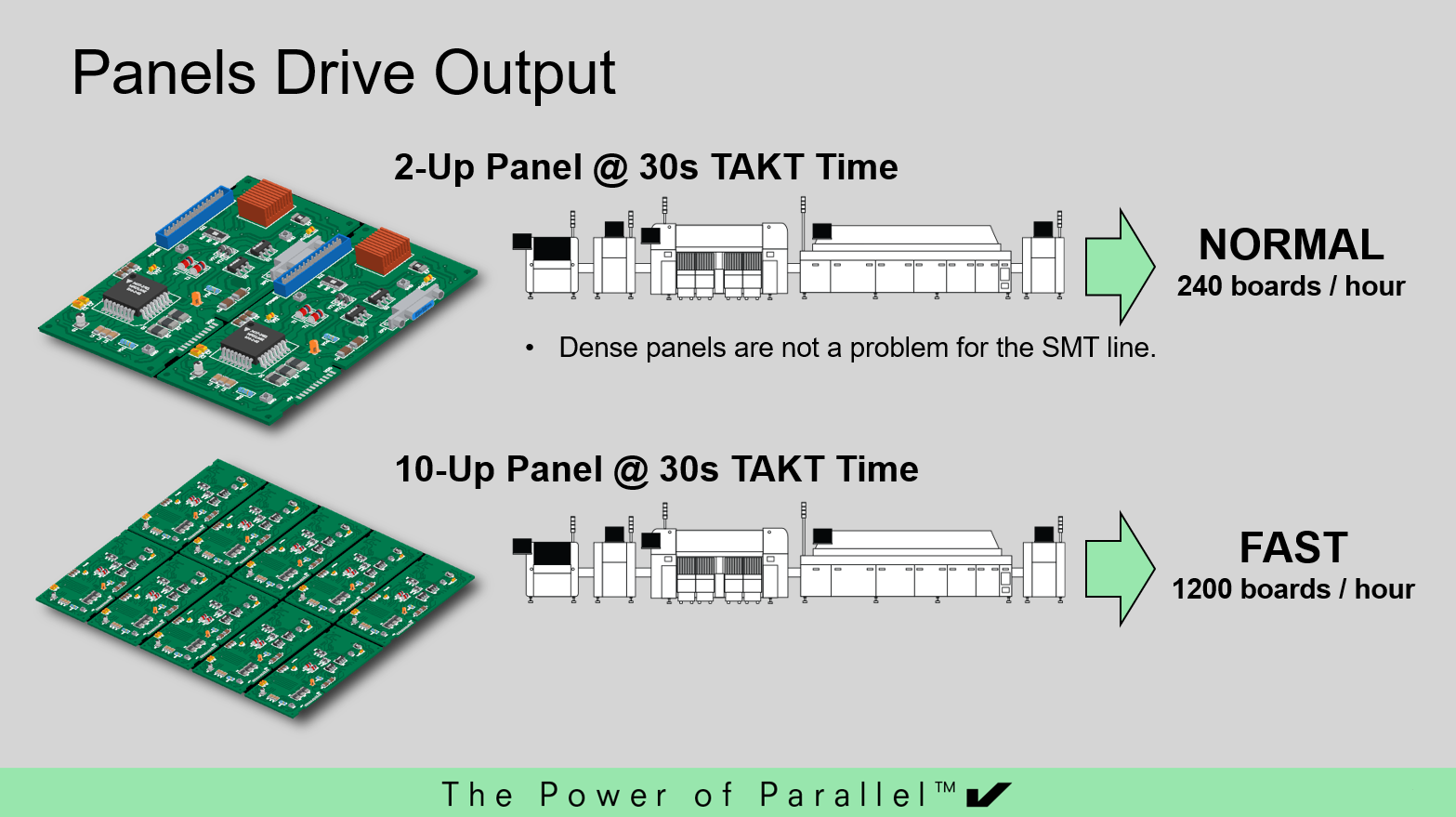
Denser panels do not necessarily create the same challenge for the upstream SMT process. Solder paste inspection processes the panel. Pick-and-place time is driven primarily by the components and placements on that panel-not simply by the number of individual PCBAs that will later be separated from it.

Production test is different. If eight assembled boards reach test in one panel and the test system processes them sequentially, many operations must be repeated eight times. The SMT line has multiplied board output per cycle, but the downstream test process has not multiplied capacity with it.

That mismatch is how an automated inline test cell-or an off-line test area that is less visible to the line-can become the next manufacturing bottleneck.

Panel Drive Output Image


Why ICT, ISP, and Functional Test Add Time Differently

Automated PCBA test commonly combines three distinct activities: in-circuit test (ICT), in-system programming (ISP), and board-level functional test (FT or FCT). Each process has different cycle-time drivers.

Test process

Common time drivers

Parallel approach

In-circuit test (ICT)

Test count, instrument switching and settling, measurements, and powered test content

Multi-Core ICT runs test content on multiple PCBAs during the same cycle

In-system programming (ISP)

File size, interface speed, memory-device limits, and the number of devices

MultiWriter™ programs multiple devices and DUTs in parallel

Functional test (FT/FCT)

Product-specific communications, stimulus, dwell time, measurements, and required sequences

Parallel Functional Test (PFT) executes eligible test content across multiple PCBAs simultaneously


Software and test-sequence improvements can remove unnecessary time, but many required operations simply take the time defined by the device, interface, measurement, or product specification. When an operation cannot be made meaningfully shorter, the practical way to increase output is to perform more work at the same time.

Is Production Test the Hidden SMT-Line Bottleneck?

When the constraint is physically on the SMT line, the production impact is obvious: the line slows to the pace of its longest operation. PCBA test is frequently performed off-line, so the SMT line may continue producing panels even when test cannot keep up.

That can make the bottleneck look like an inventory problem rather than a capacity problem. Common warning signs include:

  • A growing accumulation of untested panels or work in process (WIP)
  • Additional testers, fixtures, operators, shifts, or overtime needed to maintain output
  • Test results arriving too late to provide real-time feedback to the SMT process
  • Increased exposure to rework and scrap when a production defect affects a large batch
  • Complete test-cell cycle time exceeding the required panel takt time

The clearest capacity analysis compares the required panel takt time with the full test cycle, including automated handling, fixture actuation, ICT, ISP, functional test, and any required data or process steps. Looking only at the fastest individual test measurement can hide the actual constraint.

How Parallel PCBA Testing Changes the Math

The objective is not to force every test step to run faster. It is to build a test architecture that scales with the output of panelized production.

CheckSum applies parallelism at four levels:

  1. Multi-Core ICT performs in-circuit test on multiple PCBAs at the same time.
  2. MultiWriter™ parallel ISP programs devices directly in the fixture and can support up to 384 devices in parallel, depending on the application.
  3. Parallel Functional Test (PFT) performs eligible product-specific functional tests across multiple boards or an entire panel simultaneously.
  4. The ILS-X2 dual-panel automated test system adds parallel handling capacity, with flexible single-panel, dual-panel simultaneous, and dual-panel sequential flows based on the product and test process.

Together, these technologies can combine automated in-circuit test, in-system programming, and functional test in one production cell while increasing output without simply multiplying the number of systems, fixtures, operators, and square feet of floor space.

A Simple Parallel Functional Test Example

Consider a 10-up panel that requires a 15-second LIN communications test on every PCBA.

With a fully sequential approach, the functional-test content alone takes:

10 PCBAs x 15 seconds = 150 seconds per panel

If the test is suitable for full-panel Parallel Functional Test, the same 10 PCBAs can execute that 15-second test simultaneously. Ignoring common handling and switching overhead in both cases, that reduces the functional-test portion from 150 seconds to approximately 15 seconds-a savings of 135 seconds per panel.

The exact result depends on the board, test specification, communications architecture, and fixture design. The example demonstrates the underlying point: parallel test preserves the production benefit of higher-density panels instead of allowing that benefit to become a downstream test backlog.

Parallel Functional Test for Panelized PCBAs

CheckSum originally developed MultiWriter to solve parallel onboard-programming challenges. Customers then asked for the same throughput advantage in in-circuit and functional test.

That led to Parallel Functional Test, a project-specific platform that can execute many common board-level functional operations across multiple PCBAs simultaneously. Capabilities include communications over CAN, LIN, SPI, JTAG, UART, and other serial buses, along with voltage and current measurements, loads, and power control.

Not every end-of-line test belongs at the panel level. Tests that depend on a finished enclosure, final connector access, or complete product assembly may need to remain at end of line. But moving appropriate functional coverage earlier can reduce end-of-line load, identify defects sooner, and improve production feedback closer to the SMT process.

Match PCBA Test Capacity to SMT Takt Time

The goal is not simply the fastest individual ICT measurement, programming step, or functional test. The goal is a complete test flow that meets the required SMT takt time with the appropriate test coverage, automation, traceability, and manufacturing cost.

A CheckSum Free Project Analysis reviews the actual panel configuration, test requirements, programming files, functional-test content, handling time, and production target. The resulting capacity analysis can compare single-panel and dual-panel operation, sequential and simultaneous flows, and the appropriate combination of Multi-Core ICT, MultiWriter ISP, and PFT.

If PCBA test is creating WIP, delaying feedback, or forcing additional systems and labor, the next step is to compare your real test cycle with the line requirement.

Ready to Break Through Your Test Bottleneck?

When your SMT line is running faster than your test process can keep up, CheckSum delivers the solution.

Our automated test systems and advanced parallel test technologies are engineered for high-volume manufacturers producing panelized PCB assemblies—enabling you to test multiple boards simultaneously, dramatically increase throughput, and eliminate costly WIP bottlenecks.

Don’t let test capacity limit your factory. Contact CheckSum today to schedule a Parallel Test Project Analysis and see how you can increase test throughput, reduce manufacturing costs, eliminate WIP, and keep pace with the fastest SMT production lines.


3 min read

Keeping Up With the SMT Line Using Parallel PCBA Testing | CheckSum

Keeping Up With the SMT Line: How Parallel Testing Eliminates Manufacturing Bottlenecks Modern SMT production lines continue to get faster, smarter,...