
 John VanNewkirk
Embedding Automotive Cybersecurity Keys During Production Test -- Without Creating a New Test Bottleneck

As automotive electronics become more connected, cybersecurity is becoming part of the manufacturing process itself. For one Tier One automotive manufacturer, that meant securely embedding unique security keys into every printed circuit board assembly (PCBA) during production.

But adding cybersecurity to an already time-sensitive production-test process created a manufacturing challenge: how do you add secure key programming without slowing production?
The customer’s existing process already included separate in-circuit test (ICT) and flash-programming stations and could not keep pace with the required takt time. Adding cybersecurity increased the work that had to be completed before each PCBA could move forward.
Working with cybersecurity provider SecOps, CheckSum developed a production-test approach that combined parallel ICT, secure programming, selected functional testing, automation, and manufacturing execution system (MES) integration. The result was a faster, automated process that allowed cybersecurity to become part of production test rather than another manufacturing bottleneck.
The Manufacturing Challenge: Add Cybersecurity Without Adding Cycle Time
The customer is a leading Tier One automotive manufacturer producing human-machine interface (HMI) and electronic control unit (ECU) products.
Its PCBAs were manufactured in panels containing 20 to 40 individual boards. The existing test process used separate stations for ICT and flash programming and was already struggling to meet the required production takt time.
The new cybersecurity requirement added another important manufacturing operation: securely programming unique security keys into each PCBA.
The production-test process now needed to support:
- In-circuit test
- Product-specific flash programming
- Cybersecurity key implementation
- Selected functional testing
- Automated handling
- MES traceability
Simply adding another process step or another station would not solve the underlying capacity problem. The complete test and programming process needed to become faster.
Integrating Secure Key Programming Into Production Test
The customer partnered with SecOps Solutions GmbH for its automotive cybersecurity solution.
SecOps provided the unique cryptographically strong security keys used to establish secure communication and authentication within the automotive electronics system. CheckSum's role was to integrate secure programming of those keys into a production-test process capable of meeting the customer's manufacturing requirements.
This created an important connection between cybersecurity and production engineering. The security architecture determines what must be securely programmed. The production-test architecture determines how that operation can be performed repeatedly, traceably, and at production speed.
Parallel ICT Reduced Test Time From 40 Seconds to 10 Seconds
The first major improvement came from accelerating ICT.
Using CheckSum's Quad-Core parallel test architecture, the customer's ICT time was reduced from 40 seconds to 10 seconds.
That reduction created additional capacity within the production-test process rather than allowing the new cybersecurity operation to simply extend the existing cycle.
For manufacturing management, that distinction matters. When new product requirements are introduced, the answer does not always have to be another tester, another fixture, another operator, or another production step. Sometimes the larger opportunity is to reconsider how the required test content is executed.
Programming 40 PCBAs in Parallel
The customer's application used an Infineon 32-bit AURIX™ TriCore™ microcontroller.
CheckSum MultiWriter was deployed to support secure programming of the unique security keys supplied by SecOps, including real-time device-under-test (DUT) communication.
Instead of programming the boards individually, the complete 40-board panel could be programmed in parallel.
That changed programming from a potential bottleneck into part of a higher-capacity panel-level test process.
It also illustrates the larger production advantage of parallel testing: the required work does not necessarily change. What changes is how much compatible work can be performed at the same time.
Moving Selected Functional Test Earlier
Once ICT and programming were accelerated, the customer had additional opportunity to rethink where functional testing occurred.
CheckSum Parallel Functional Test (PFT) was used to perform LIN communications testing and other measurements across all 40 PCBAs in one pass.
Performing these functional checks at the panel level reduced the burden on end-of-line (EOL) testing and provided earlier identification of potential faults.
That can have consequences beyond test time. Finding a problem earlier means production receives feedback sooner. It can reduce the amount of additional product manufactured before a process issue is identified and reduce the amount of verification that must be concentrated at EOL.
The objective is not simply to move every functional test upstream.
It is to determine which tests can be performed effectively earlier and build the production-test sequence around the application's actual requirements.
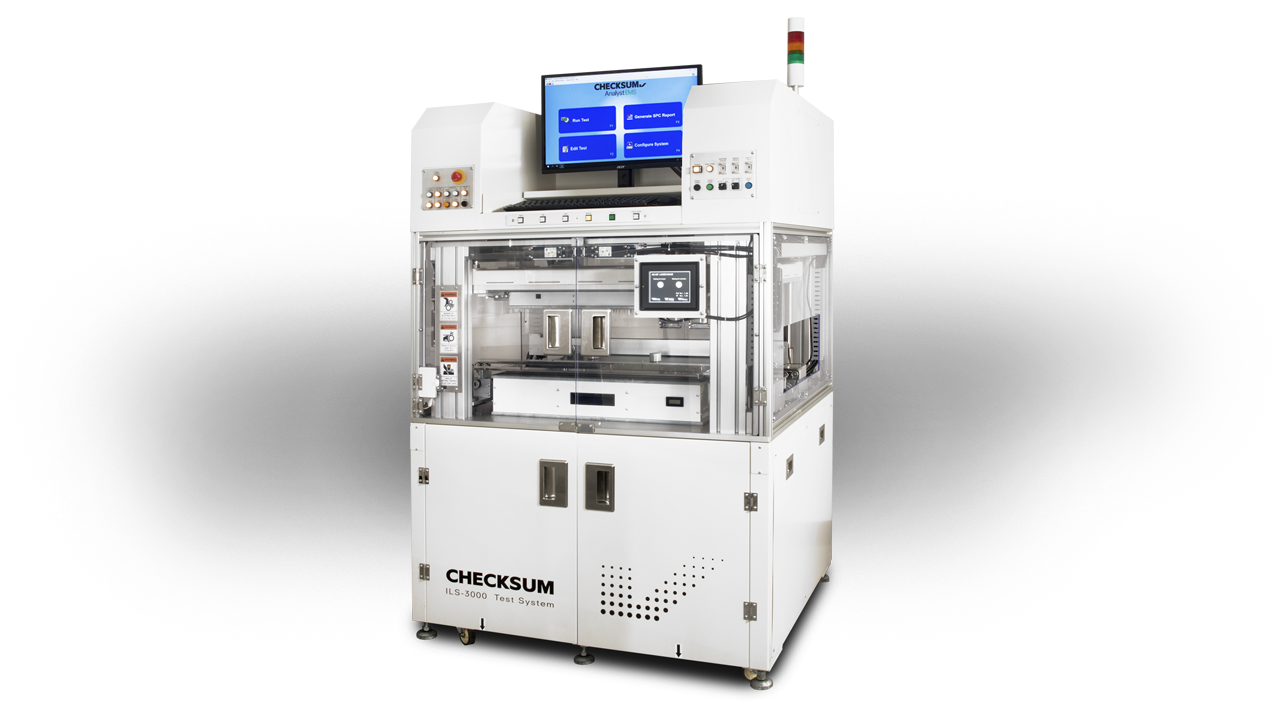 CheckSum ILS-3000 Automated Test System
Faster test and programming also made automated handling practical.
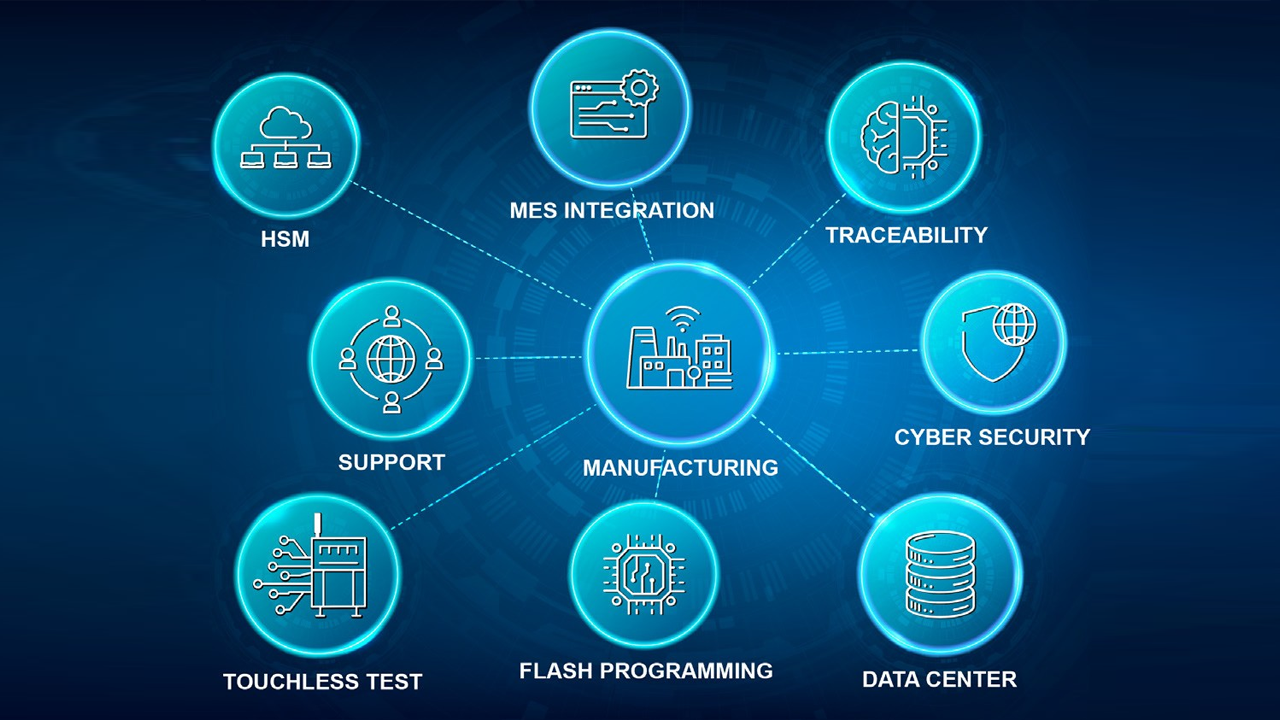
The production process incorporated CheckSum's automated in-line test handling, creating a Touchless Test operation. Machine setup included barcode scanning of fixtures and a golden-sample process, while CheckSum's test-system process control and reporting were tightly integrated with the customer's MES.
This addressed several manufacturing objectives at once: reducing manual intervention, improving operational efficiency, supporting traceability, and creating a repeatable process for cybersecurity implementation.
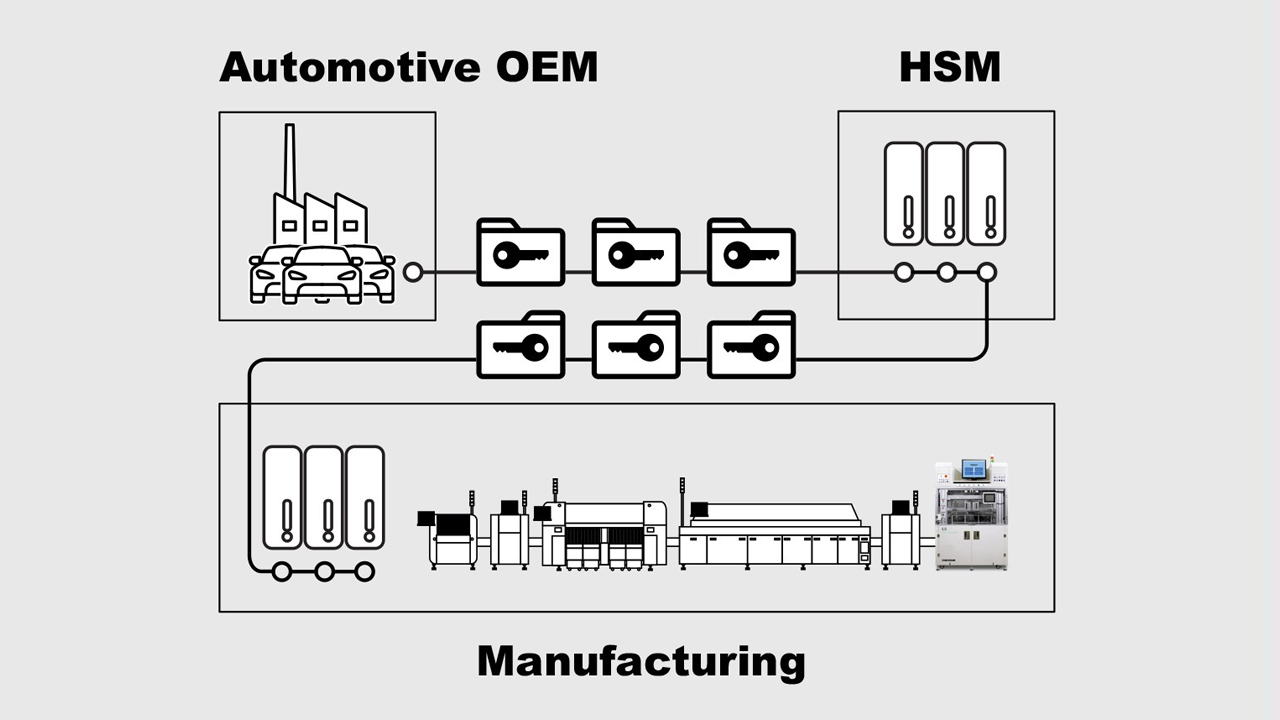
Cybersecurity Became Part of the Production Flow
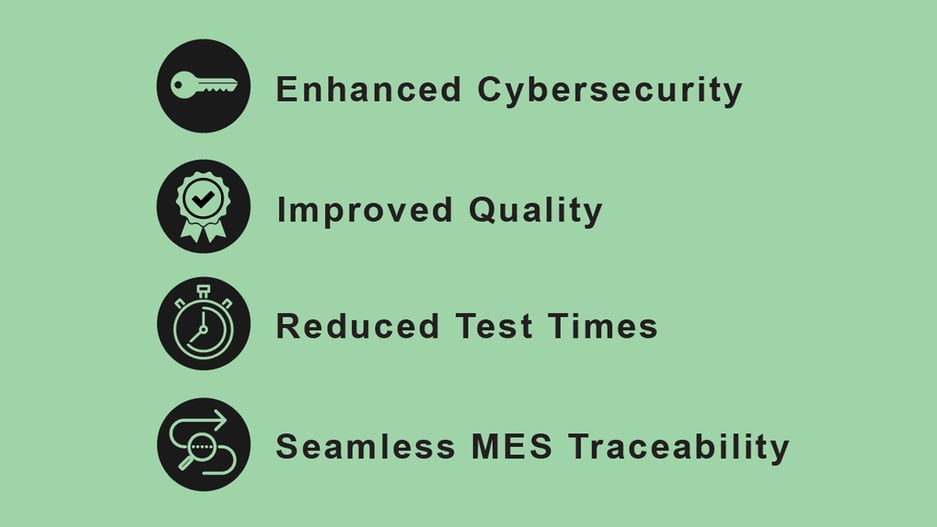
The project produced four important outcomes: enhanced cybersecurity, improved quality, reduced test times, and seamless MES traceability.
More importantly, the customer did not have to choose between adding cybersecurity and maintaining manufacturing performance.
By combining SecOps' cybersecurity technology with CheckSum's parallel production-test architecture, the customer could securely embed unique keys while also accelerating ICT, programming entire panels in parallel, moving selected functional tests earlier, automating handling, and integrating the process with MES.
Manufacturing takeaway:
When a new product requirement adds time to production test, don't look only at the time being added. Look at the architecture of the entire test process.
There may be opportunities to perform more compatible work simultaneously, consolidate operations, reduce handling, and create enough capacity to absorb the new requirement without creating another bottleneck.
What Could a Different Production-Test Architecture Change in Your Application?
Every production-test process has its own combination of board or panel configuration, ICT requirements, programming time, functional tests, cybersecurity requirements, takt time, automation, and MES integration.
CheckSum's Free Test Application Analysis evaluates those requirements together to determine how the test mix, parallelism, programming, functional test, and handling sequence can be optimized around the actual production process.
Request a Free CheckSum Test Application Analysis
See what a different production-test architecture could change in your application.